
 Connect Sign In













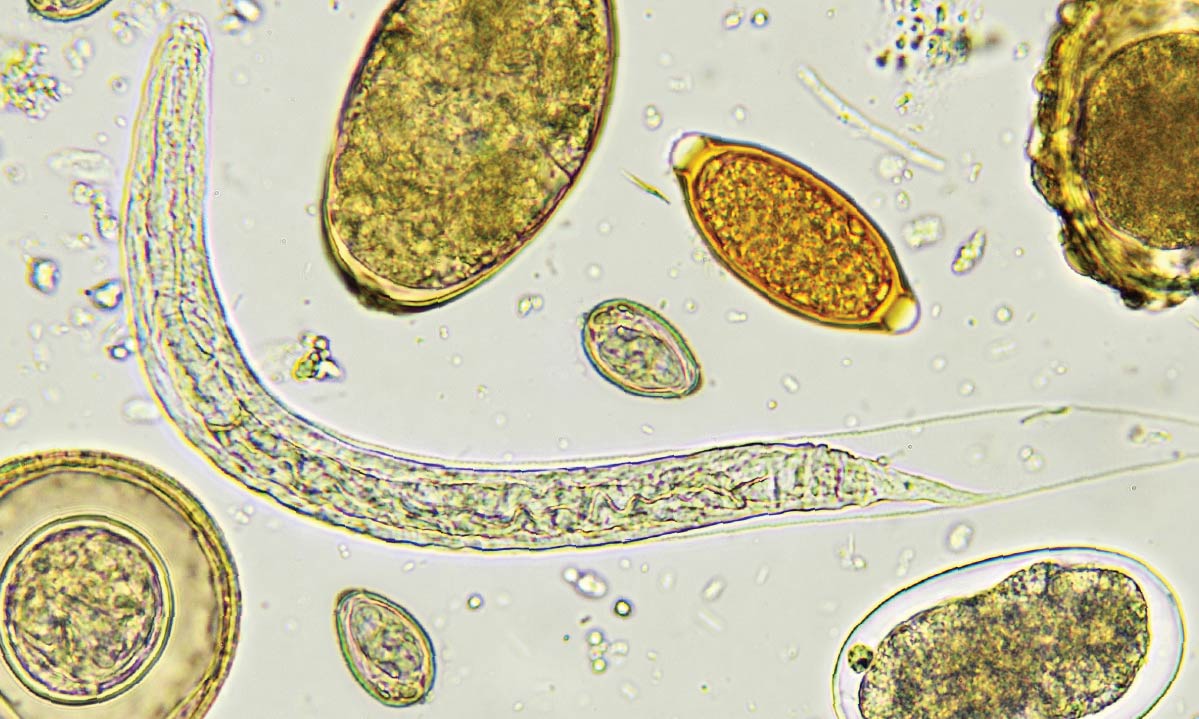
Following the implementation of an AI-based wet mount screening platform, Enterobius vermicularis (pinworm) detection increased fivefold.


A new study by ARUP Laboratories determined that using an artificial intelligence (AI)-based wet mount screening platform (AI-WM) for helminth detection increased diagnostic yield. This increase may suggest that helminth infections are more common in the United States than previously assumed or indicate a gap in diagnostic testing.
Helminths are parasites that resemble worms with elongated bodies. Common helminths include tapeworms, roundworms, flukes, and pinworms. For the most prevalent helminth detected, Enterobius vermicularis, positivity rates increased fivefold.
The study, “Diagnosing Helminth Infections in a Large Reference Laboratory in the United States: a 6-Month Pre- and Post-Implementation Analysis of AI-Augmented Screening of Concentrated Fecal Wet Mounts,” was published in the Journal of Clinical Microbiology.
“AI-based screening increases sensitivity of the ova and parasite assay significantly,” said Blaine Mathison, BS, M(ASCP), technical director of Parasitology at ARUP. “The AI was able to detect a single egg or larva in nearly one-quarter of the positive cases.” Mathison has been involved in the validation of AI-based screening for ova and parasites from the initial stages of development.
ARUP was the first laboratory in the world to fully implement AI-based screening for the detection of human gastrointestinal parasites in ova and parasite (O&P) exams, initially launching an AI-based screening platform for trichrome stains in 2019. ARUP then expanded the AI screening platform to include wet mounts in 2025.
The study compared helminth positivity rates from the six months before the implementation of the AI-WM (September 27, 2024, to March 26, 2025) and the six months following the AI-WM implementation (March 27, 2025, to September 29, 2025), as well as historical data from 2021 to 2023. Helminth-positive cases increased from 29 (29/36,334 patients) before implementation to 104 (104/43,545 patients) after implementation.
“While prevalence of helminth infections remains low overall, we observed a significant increase in detection when using the AI-based platform as a prescreening tool,” said Cole Anderson, PhD, a microbiology fellow at ARUP and first author of the study.
Enterobius vermicularis infection, commonly known as pinworm, is one of the most prevalent parasitic infections in the U.S. Symptoms typically include nocturnal perianal pruritus, although many who are infected do not experience symptoms. The cellulose tape test or the use of commercial paddles remain the recommended approaches for detecting pinworm infections, but the increased detection via O&P fecal testing may indicate a gap in ordering patterns or diagnostic testing. The authors, however, make no claim that the O&P examination should replace conventional testing.
The increased sensitivity of AI-based screening offers clear advantages compared with manual microscopy alone, which poses several challenges in detecting species such as helminths. Eggs may be shed in limited numbers, making detection difficult. Manual microscopy is also labor intensive and requires extensive experience and training.
An article describing ARUP’s validation of the AI-WM platform was published in the Journal of Clinical Microbiology in 2025; that validation also established the model’s sensitivity and reliability for detecting gastrointestinal parasites. AI-WM is used as a prescreening tool only. Each case is reviewed and confirmed by trained specialists along with laboratory or technical directors as needed.
The study also found that use of AI-WM shortened the time that providers and patients were waiting for results: The test turnaround time decreased from 5.2 to 4.0 days.
“When we combine human expertise with artificial intelligence, we create powerful tools to better detect disease and improve patient care,” said Adam Barker, PhD, ARUP chief operations officer and president of the Reference Business Unit.
Read the full article in the Journal of Clinical Microbiology: https://journals.asm.org/doi/10.1128/jcm.00165-26.
Kellie Carrigan, kellie.carrigan@aruplab.com
