
 Connect Sign In















The dashboard uses deidentified test results to reveal national trends that may help clinical laboratories, medical directors, and clinicians detect unusual patterns, seasonal shifts, and emerging infectious disease activity.
- Select by Disease
- A. phagocytophilum
- B. microti
- Cyclospora
- E. chaffeensis
- Measles
- B. pertussis
- S. pneumoniae
- VZV
Anaplasma phagocytophilum
ARUP Test: Ehrlichia and Anaplasma Species by PCR

Important Information
Cases of anaplasmosis have been increasing, especially over the past five years. It is most frequently reporting in the Midwest and Northeastern US.
Additional data are available from the CDC: https://www.cdc.gov/anaplasmosis/hcp/statistics/index.html
Babesia microti
ARUP Test: Babesia Species by PCR

Important Information
Babesiosis, historically concentrated in the Northeast and Upper Midwest, is expanding in the Mid-Atlantic region. Source: https://academic.oup.com/jme/article-abstract/62/4/995/8117626.
Additional data are available from the CDC: https://www.cdc.gov/babesiosis/php/data-stats/index.html
Cyclospora cayetanensis

Ehrlichia chaffeensis
ARUP Test: Ehrlichia and Anaplasma Species by PCR

Important Information
E. chaffeensis is the primary agent for ehrlichiosis in the United States. Cases have historically been concentrated the South central, Southeastern, and Mid-Atlantic U.S. Vector expansion into states such as Connecticut and incursion of a new tick vector (H. longicornis) have increased the risk of ehrlichiosis in the Northeast.
Additional data are available from the CDC: https://wwwnc.cdc.gov/eid/article/31/6/25-0034_article
Measles virus
ARUP Test: Measles Virus by Qualitative NAAT
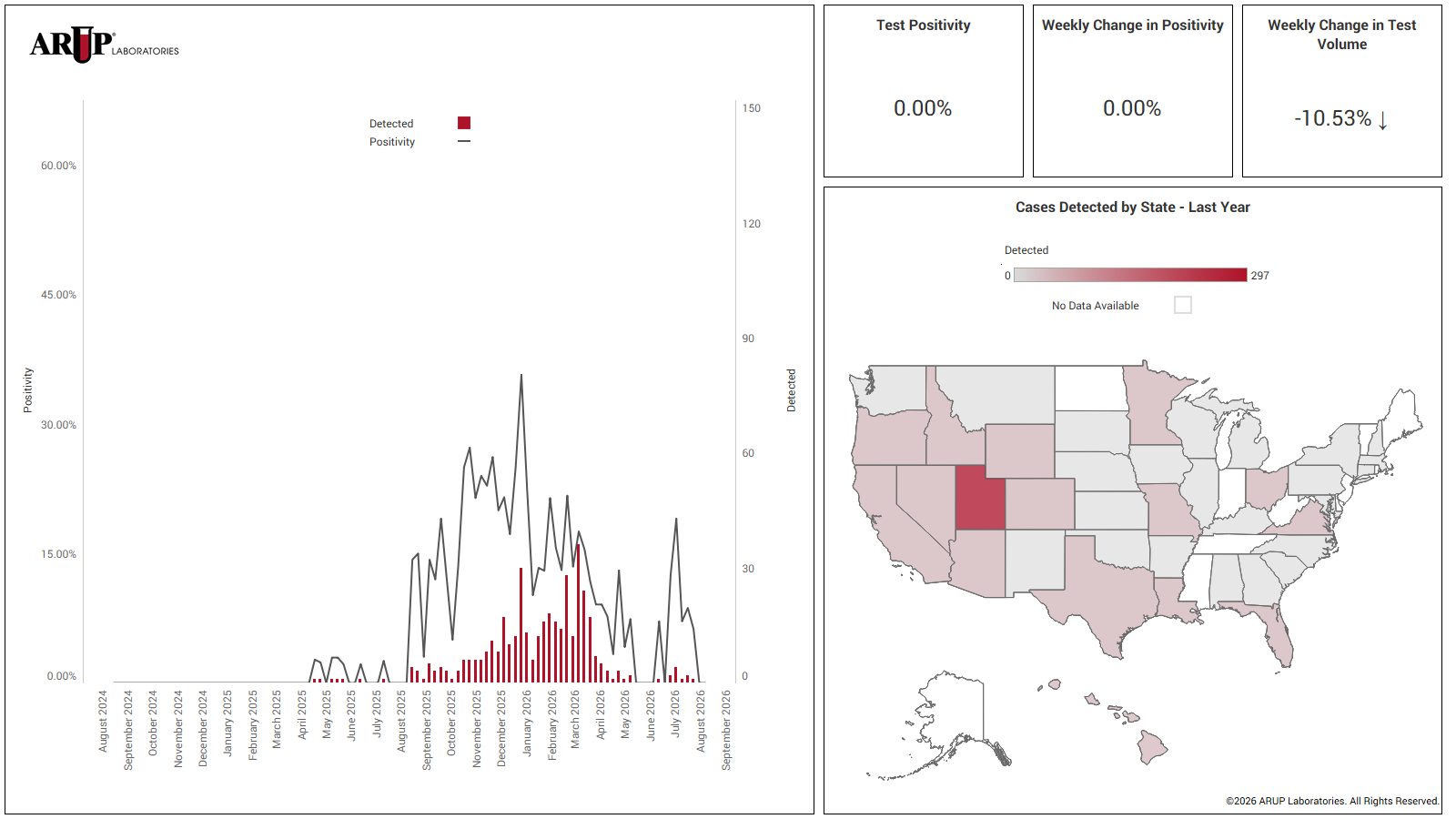
Important Information
Multiple large outbreaks of measles have been identified in several states including Texas, South Carolina, and Utah. Current information regarding ongoing outbreaks is available at: https://www.cdc.gov/measles/data-research/index.html
Bordetella pertussis
ARUP Test: Bordetella pertussis/parapertussis by PCR

Important Information
Recent surges of pertussis have been documented in 2024 and 2025 with over 43,000 and 28,000 cases respectively. Thus far, activity in 2026 has remained below the prior two years.
Additional data available: https://www.paho.org/en/documents/epidemiological-update-pertussis-whooping-cough-americas-region-25-march-2026
Streptococcus pneumoniae
ARUP Test: Streptococcus pneumoniae Antigen, Urine

Important Information
S. pneumoniae is a frequent cause of community acquired pneumonia. Activity often peaks during the winter. Pneumococcal vaccines are available for adults age 50 or older and those with certain risk factors. Both PCV and influenza vaccination have been shown to lower the risk of developing pneumococcal pneumonia.
Varicella-zoster virus
ARUP Test: Varicella-Zoster Virus by PCR

Important Information
This assay does not distinguish primary infection (varicella) from reactivation (herpes zoster). Varicella is not considered a notifiable condition in some health jurisdictions; therefore, national data may underestimate the true incidence.
This dashboard contains data from testing performed at ARUP Laboratories and is not intended for comprehensive national disease surveillance or epidemiologic reporting. Data are updated weekly.
