
 Connect Sign In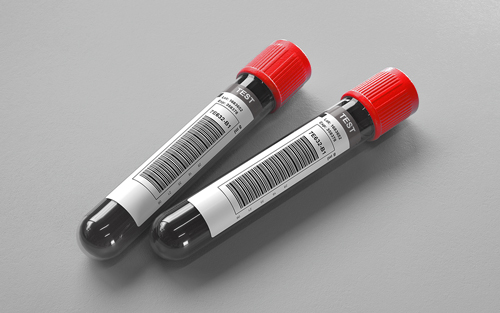














ARUP Laboratories is advancing innovative diagnostics for Alzheimer’s disease and other neurodegenerative diseases to provide clinicians and patients with accurate, actionable insights.
Deliver the best possible care by incorporating ARUP’s comprehensive suite of Alzheimer’s disease (AD) tests into your diagnostic workup. Featuring the advanced blood-based biomarker pTau 217, our portfolio reduces reliance on invasive procedures and supports timely and informed clinical decision-making for improved patient outcomes.
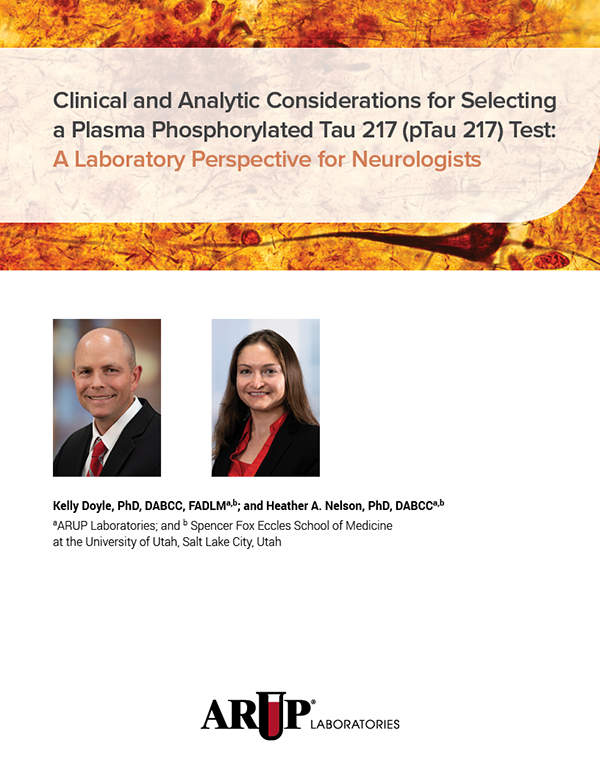
Featured Test
Advantages of ARUP's Blood-Based Biomarker Testing: Phospho-Tau 217, Plasma (3019017)
 Guideline-aligned performance
ARUP's brain-derived pTau 217 test is appropriate for confirmatory use in individuals presenting with cognitive decline, demonstrating ≥90% sensitivity and specificity with an indeterminate rate ≤20%.1
 The most accurate blood-based biomarker
Among all standalone blood-based biomarkers for AD, pTau 217 demonstrates the highest accuracy in predicting amyloid PET positivity.2
 A standalone biomarker for superior performance
ARUP’s pTau 217 assay uses advanced antibody technology, including an antibody specific to brain-derived tau, enabling robust diagnostic accuracy without the need for supplemental biomarkers or ratio calculations.
Why Choose ARUP?

Expert Guidance
Our medical directors guide test development and are available for consultation on test ordering and result interpretation.

Evolving Test Menu
We continually expand our test menu based on the latest in research, guidelines, and technology.

Comprehensive Testing Solutions
Our test menu includes FDA-approved cerebrospinal fluid biomarkers, phosphorylated tau 217 (pTau 217) in plasma, and apolipoprotein E (APOE) testing for amyloid-related imaging abnormalities (ARIAs) risk assessment.

Cutting-Edge Solutions
ARUP has expertise in translating innovation to application, and we continue to seek out partners with whom we can work to develop diagnostics that will have direct clinical impact.
In the News
ARUP Consult®: Laboratory Test Selection Support
Topics
Test Fact Sheets
- Phospho-Tau 217, Plasma
- Alzheimer's Disease Markers, CSF
- Apolipoprotein E (APOE) Genotyping, Alzheimer Disease Risk
Additional Resources
- Video Lectures
Innovations in Diagnostics for Alzheimer’s Disease and Related Dementias
Qinwen Mao, MD, PhD Subspecialty Director, Neuropathology, ARUP Laboratories, Professor, University of Utah School of Medicine
Plasma-Based Diagnostics for Alzheimer’s Disease: Current State and Clinical Relevance of pTau 217
Christine Cliatt Brown, MD, Behavioral Neurologist, University of Utah Health, Assistant Professor, Division of Cognitive Neurology, Spencer Fox Eccles School of Medicine at the University of Utah
Kelly Doyle, PhD, DABCC, FADLM, Special Chemistry, Endocrinology, and Mass Spectrometry, ARUP Laboratories, Associate Professor (Clinical), Spencer Fox Eccles School of Medicine at the University of Utah, Medical Director
- LabMind Podcast
An Interview With Dr. Qinwen Mao: Why We Need Better Laboratory Tests for Dementia
Additional Tests
Apolipoprotein E (APOE) Genotyping, Alzheimer Disease Risk (2013341)
- APOE testing is recommended to assess risk of amyloid-related imaging abnormalities (ARIA) when prescribing amyloid-targeted antibody treatments.
Alzheimer's Disease Markers, CSF (3017653)
- This test uses FDA-approved kits and instrumentation. Its performance is backed by significant data, and test results have been demonstrated to closely correlate with amyloid PET scan results.
- Test results provide two ratios: Phospho-tau(181)/Abeta42 ratio and total tau/Abeta42 ratio, which offer better concordance with amyloid PET imaging when compared to Abeta42, pTau 181, and tTau individually.
- Palmqvist S, Whitson HE, Allen LA, et al. Alzheimer’s Association Clinical Practice Guideline on the use of blood-based biomarkers in the diagnostic workup of suspected Alzheimer’s disease within specialized care settings. Alzheimer’s Dement. 2025;21:e70535.
- Willis DR, Summanwar D, Brosch JR. Blood biomarkers and early detection of Alzheimer's disease and related dementias. Fam Pract Manag. 2025;32(3):17-20.
