 Connect Sign In


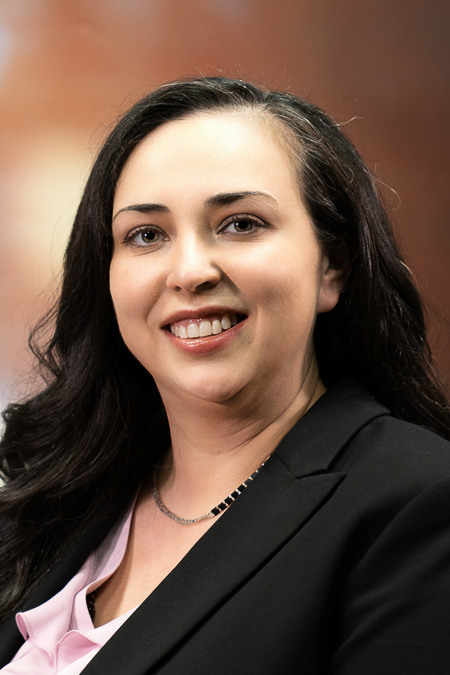
Bella Church Pieces Puzzles Together for ARUP Healthcare Advisory Services Clients


In 2006, ARUP Senior Healthcare Consultant Bella Church, MS, C(ASCP) CM, was dreaming of her future as a clinician after receiving her master’s degree in exercise physiology from the University of Utah. First, however, she needed an interim job to keep the lights on while she planned her next steps. Luckily, a family member already employed at ARUP was able to help her land one—a technologist trainee position in what was then known as the Trace Elements and Calculi Laboratory.
It meant taking a side step from her plans, but every day at the bench, she found herself enthralled by the puzzle-like nature of clinical testing. In every specimen, she saw patterns to be determined and a specific riddle to be solved. Computers hadn’t yet become ubiquitous and powerful enough to assist with large amounts of laboratory work. While the testing itself involved puzzle solving, processes weren’t particularly efficient.
“Everything was manual then. Everything,” Church said. “You had to take very detailed notes and write a lot of physical descriptions by hand. We were entering information into old MS-DOS programs. The IT department didn’t really have resources for a bench-level interface, and there were no templates for this kind of work.”
Church said she felt there must be a more efficient way to report on specimens. She opened a Microsoft Excel file, and using Visual Basic commands she’d learned, she created a rudimentary automation interface to streamline data entry. Instead of typing paragraphs of information, she devised a numeric code to allow technicians to enter everything with a few keystrokes.
“For instance, if you were dealing with a kidney stone, you would have to write out that it was orange, and it was a certain size, among other things,” Church said. “I was by no means a programmer—and it was very, very basic—but I defined some commands where you could use a 10-key number pad instead. You could, say, hit ‘8’ for orange, and mark the size as ‘1,’ as well as a few other variables. Then, it output to an Excel sheet and we put that into Pathnet Classic.”
Her supervisors took the creation seriously. It led to cleaner reports—no spelling errors, no missing spaces, and better formatting so that reports could be more easily read by clients. Critically, though, it instantly made work more efficient for technicians and reduced turnaround times. For Church, it was one of the earliest steps into the oncoming wave of automation that would crest over the next couple of decades. She said the lab used her Excel program for “seven or eight years” before ARUP’s IT team created what was essentially a standalone version of her system.
Church never turned back to her plans to become a clinician. Instead, in 2026, she’s celebrating her 20th year at ARUP. The puzzles, she said, and her desire to solve them, simply never waned. She realized medical laboratory science, which she called the “quiet backbone of healthcare,” was the place where she could have the greatest effect on patient outcomes. One test improvement could affect thousands of patients at once.
By 2009, she had been promoted to technical specialist and was extending her expertise to mass spectrometry testing while also becoming more involved in space planning and test validation. She led the charge in moving the Trace Elements clean room when ARUP relocated it to a new facility some years later. In 2012, she moved into a lead position in the Clinical Toxicology 1 Laboratory, where she could delve more deeply into mass spectrometry work. It was the perfect fit for her methodical mind. By 2016, Church was the technical supervisor of ARUP’s Clinical Toxicology 2 Laboratory.
“There are no out-of-the-box tests in mass spectrometry,” she said. “Everything in mass spec is lab developed. Looking at chromatograms is like looking at a logic puzzle. There are all these pieces that must be there for you to report patient results, and that’s motivating and fun for me.”
One test ARUP did not perform in-house during this period was a whole blood test for phosphatidylethanol (PEth), a biomarker associated with alcohol consumption. Once Research and Development (R&D) validated an in-house test, it was up to Church to implement it—and taking a new test live on a new instrument platform is a bit of a high-wire act. The stakes were high. They rose even higher as the test finally went live for clients in early 2020, just as COVID-19 began sowing chaos.
“We knew as soon as we flipped the switch—it wouldn’t be a slow ramp-up,” Church said.
Before the launch, ARUP was receiving 1,000 to 2,000 specimens per month for the whole blood PEth test that were passing through to referral partners. Church said she knew those numbers would grow as clients found the test easier to access, so she wanted to make sure her lab could handle even larger volumes.
“It was the right move, because by the end of that year, we were processing up to 6,000 specimens per month,” Church said.
Most of the PEth test procedures Church helped establish are still in use today, with a handful of upgrades to handle even larger volumes. ARUP now performs more than 10 times the number of tests that were being referred at the point that ARUP’s test went live. Some of those upgrades happened as Church’s lab moved into a new facility, which she helped to design.
In 2021, Church joined ARUP Healthcare Advisory Services and now leverages the experience she gained during her years at the bench to develop efficient strategies for ARUP’s clients, whether for individual diagnostic tests or for enterprisewide process optimization. She still finds major puzzles to crack, both in the lab and across the industry. She notes that clients ask about new opportunities for automation, something she understands intimately because of her work in mass spectrometry.
“Anyone who has experienced pipetting into a 96-well plate knows that can be a hard task,” Church said. “There are so many little mistakes that could be made, and in working with mass spectrometry, we worked with so many things manually. Automation ideas came naturally out of that.”
Church said medical laboratory science’s constant learning environment remains rewarding, and she has had the opportunity to improve outcomes for far more patients in the lab than she might have as a clinician.
“I was lucky to have many years solving a variety of interesting problems in my lab work, and now I get to apply that experience to our clients,” she said. “Each one has a unique challenge that requires unique solutions. I’m glad I get to play a role here.”